If a chair you make is to last a hundred years, every layer in it has to last a hundred years. The cheapest material you put in becomes the lifetime of the whole: skimp on the webbing and the springs sag in twenty years; skimp on the hessian and the stuffing falls through; skimp on the calico and the show fabric distorts.
There is no hierarchy of importance among the materials of a traditional chair — each one is the chair’s lifespan in waiting. This chapter is the field guide to all of them. It’s deliberately a reference chapter rather than a teaching one: you don’t read it cover to cover, you look things up in it. And it’s organised by what each material does in the chair, not by what it’s made of — so jute and rubber webbing share a section because they do the same job, and horsehair and foam share a section because they do the same job.
I don’t name most suppliers here — they change. Livedale Upholstery Supplies is currently our main one, partly because they’re literally down the road from the workshop. For anything you can’t source locally, a good trade supplier will carry every material in this chapter under one roof.
Frame timbers
The wood the frame is made from sets the upper bound on what the rest of the materials can do. A frame that flexes under load will pop staples, snap webbing and fail stitches however carefully you fitted them. The traditional British frame is beech, with ash in the curved members; older or higher-end pieces are oak or mahogany; modern factory pieces are increasingly laminated birch ply.
Beech is the workhorse: dense, straight-grained, holds tacks and staples without splitting, turns predictably for legs. Its drawback is weight — a pair of solid beech armchairs is a heavy thing to carry up two flights. Ash is lighter, springier and bends well under steam, so the curved members of a wing-back or the bowed front rail of a Regency couch are usually ash; it’s harder to find clean now because of dieback, so expect prices to keep rising. Oak is the mark of an old or high-end frame — hard to tack without pre-drilling, and its tannins react with steel to streak the show fabric black over years. Mahogany is essentially extinct as a new timber but constant in restoration; beautiful to work, but it embrittles over a century, so tap-test before you trust it. Laminated birch ply is the modern factory choice — cheap, stable, light — but staples don’t hold in plywood after one re-cover; the hole rounds out and the next staple has nothing to grip. Ply-framed pieces are often single-use upholstery.
Oak’s tannins react with iron, and even galvanised steel tacks can produce visible black lines on the underside of fabric after twenty years. Stainless tacks cost twice as much and last forever. On any oak frame, pay the premium — and never use plain steel.
Webbing — the suspension layer
Webbing is the suspension system of the seat. Done well it lasts thirty to fifty years; done badly, two. Three families are in current use. Jute is the trade standard for traditional work — plain English jute is yellow-tan, woven flat, 50 mm (2 inches) wide (paid link), about a pound a metre; the black-and-white striped variant is heavier and carries spring tension better, so we keep it for heavily-sprung pieces. Rubber (Pirelli) webbing is the post-1950 elastic alternative used to suspend cushions in mid-century modern chairs; it works beautifully for a decade and then perishes, so on any Robin Day or Ercol piece you replace all of it as a matter of course and never trust the original. Elastic webbing is the modern factory type — polyester woven with elastic threads, cheaper and easier to fit and worse in every long-run measure; fine in modern foam pieces, never in restoration.
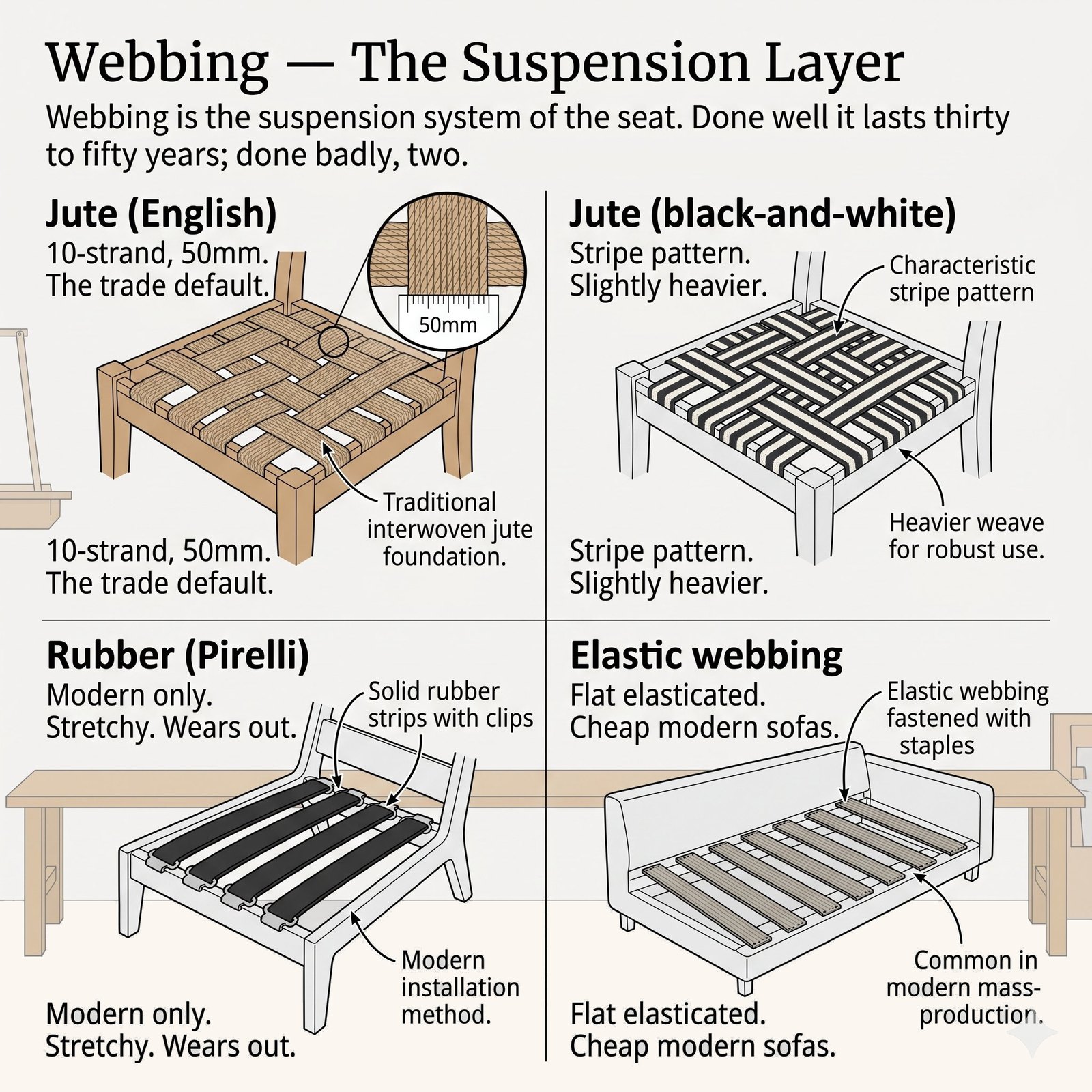
Jute webbing should be fitted at about 10% stretch — you can feel the tension when you tap it with a finger; it should “ring” like a slack drum head, not slap limply. The tension test is covered properly in the webbing chapter.
Hessian, scrim and calico — the structural cloths
Three weight classes of plain-woven jute or cotton cloth that do structural work inside the chair. Hessian — burlap, in American books — is the heavy jute cloth that sits over the springs and contains the first stuffing; the trade weight is 12 oz per square yard (paid link), lighter weights tear under horsehair and heavier ones are unnecessary outside industrial work. Scrim is its lighter sibling, around 7–8 oz, used to wrap the first stuffing once it’s bridled into shape — it’s what your blind stitches go through when forming a stitched edge, and quality varies alarmingly, so spend a little more to avoid an open weave that lets the stuffing poke through. Calico is plain unbleached cotton (paid link), the under-cover between the second stuffing and the show fabric; we use 7 oz for everything. Bottoming cloth — the dark cloth tacked under a finished chair to hide the webbing — is really a finishing material, and black is overwhelmingly the standard.
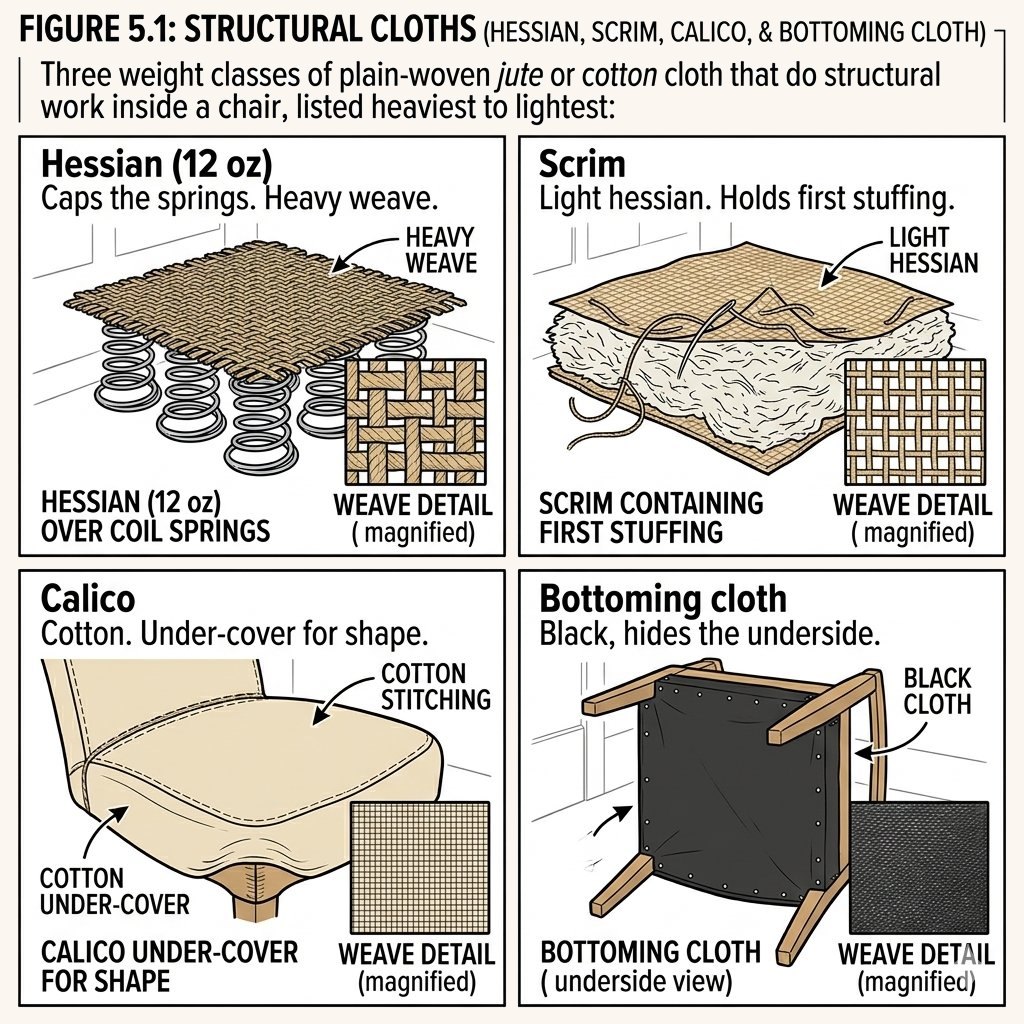
Calico is unbleached for a practical reason: bleached cotton carries optical brightening agents which yellow over time. Unbleached calico is the same colour at decade twenty as it was on day one.
Stuffings — the structural fillings
Horsehair is the traditional king, used continuously since at least the seventeenth century. Curled (“crimped”) horsehair has natural springiness, lasts essentially forever in clean dry conditions, and can be teased and re-teased through several re-stuffings — stripped from old chairs and re-used, it gets better with age. The drawback is price (new horsehair is around fifty pounds a kilo (paid link)) and availability; most sold today is imported and mixed with hog hair. Coir is the historical second-string — the brick-red fibrous husk of coconuts, less springy, more economical, used in Victorian commercial work for the bulk of the seat with horsehair only on top. Palm fibre is similar, slightly finer and softer. Wool and hog hair are the softer fibres of the second stuffing, where structural stiffness is no longer needed. Cotton felt is the smoothing layer between the second stuffing and the calico — no structural job, it just hides unevenness below. Polyester wadding (trade name Dacron) is the modern alternative to cotton felt; we use Dacron over modern foam and cotton felt over traditional stuffings, where a synthetic next to natural fibre would feel wrong. Polyurethane foam is the modern stuffing (see the density chart below), and latex foam — natural vulcanised rubber — is the high-end alternative: longer-lived, more responsive, and worth the premium on top-tier modern work.
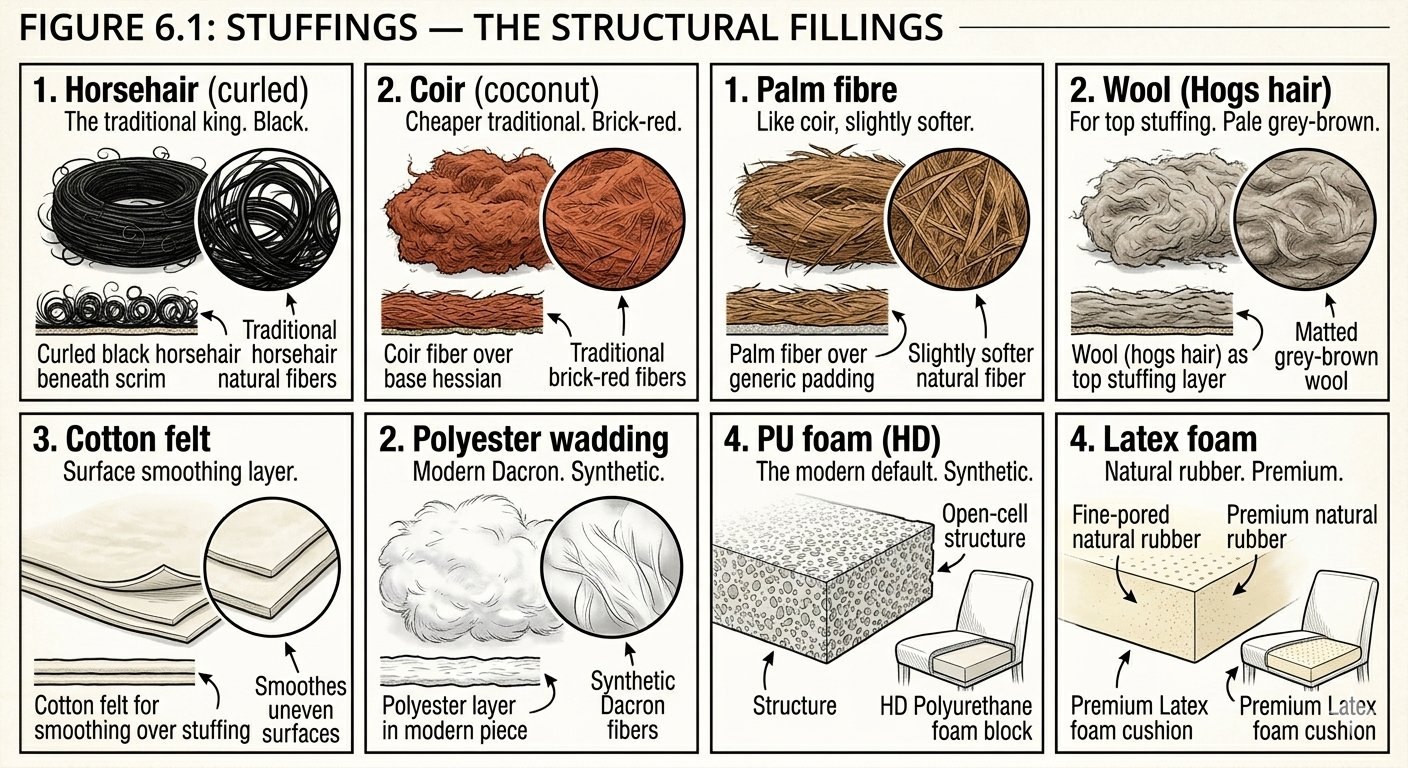
When you strip an old chair, the horsehair you find is almost always re-usable. Tease it apart, clean it (a hot wash and a steam is enough), and you have free stuffing for your next traditional job. We have horsehair in our current chairs that we know first went into a piece in the 1880s.
The foam density chart
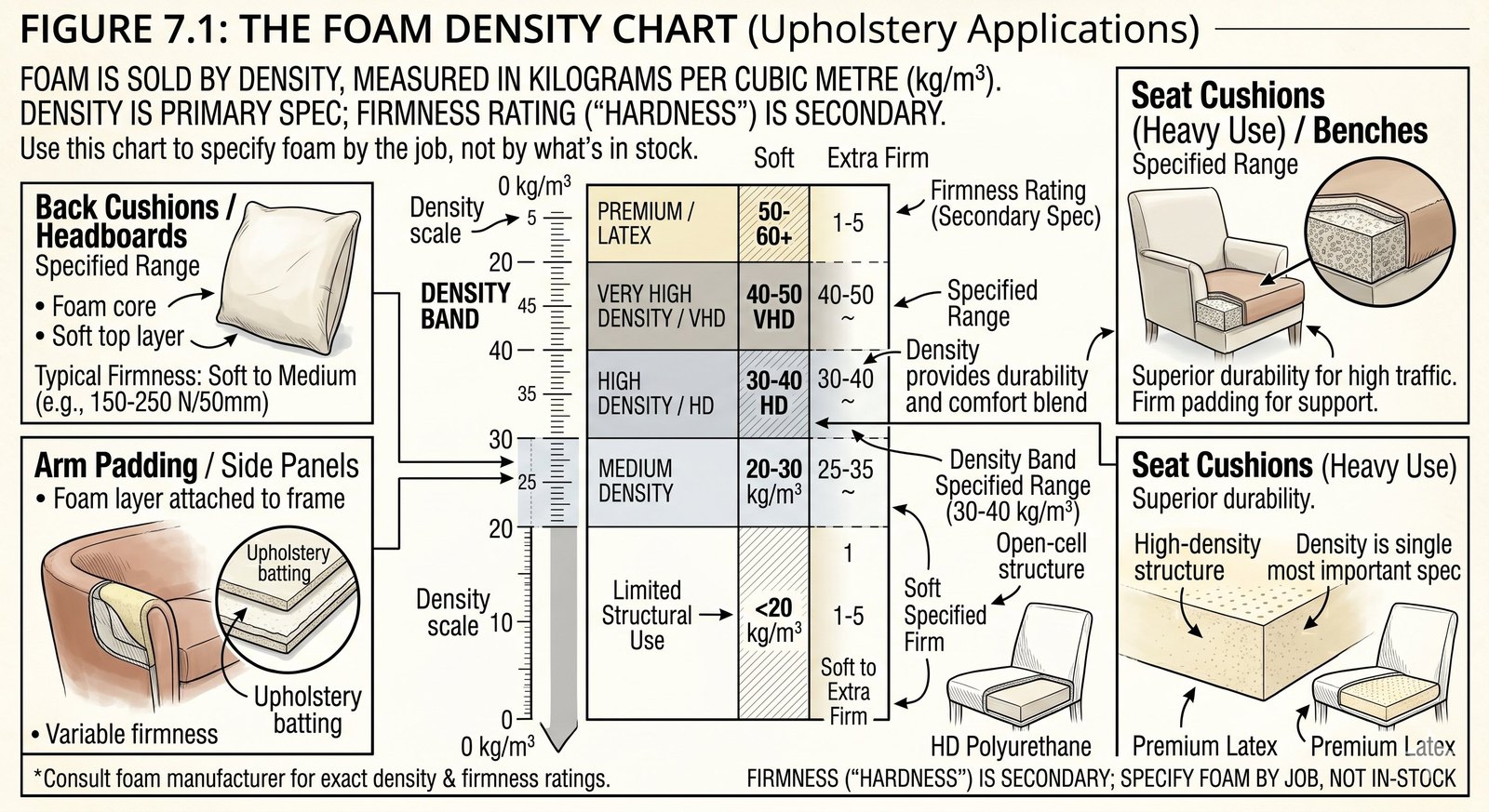
Foam is sold by density, measured in kilograms per cubic metre — and density is the single most important spec. Firmness rating (“hardness”) is secondary. The mistake that catches every beginner is buying “medium foam” from a shed-supplier, which can be anything from 18 to 30 kg/m³; the 18 kg version collapses in eighteen months. Specify foam by the job, using the chart, not by what’s in stock.
Twines, threads and cords
Five named cords, each with a specific job. Laid cord is the heavy hemp cord used to lash the heads of coil springs together in the 8-knot pattern — sold by the ball, everlasting in dry storage, and never to be substituted with synthetic twine, which slips at the knots. Mattress twine is the medium-weight waxed twine for the blind- and top-stitching of stitched edges; the wax keeps it sliding through scrim without fraying, and we use natural for everything. Buttoning twine is a heavier twine marketed for tying buttons through chair backs, but mattress twine doubled is fine — save your money. Slipping thread is the thin polyester or nylon used to hand-stitch show-fabric closures (a No. 8 polyester is the modern standard, matched to the fabric). Bridle twine is the light hemp used for the bridles that hold first stuffing in place before scrim — often the same as mattress twine, the distinction mostly marketing.
All upholstery twines benefit from waxing before use. Pull the cord through a block of beeswax once or twice before stitching; it slides better, doesn’t fray, and keeps the knots tight. A beeswax block lasts for years.
Tacks, staples and the things that fix them
Upholstery tacks are sold by length and head type. The standard sizes are 6 mm (¼″), 10 mm (⅜″), 13 mm (½″) (paid link) and 16 mm (⅝″): use 13 mm for webbing, 10 mm for hessian and scrim, 6 mm for top fabric. There’s also a “fine” designation for thinner shafts where you don’t want to split a thin rail. Staples for the pneumatic gun come in widths and leg lengths; the trade standard is the 71-series staple (paid link), 10.6 mm wide in 6–14 mm legs — 8 mm for top fabric, 10 mm for hessian, 12 mm for webbing, bought in boxes of 5,000. Decorative nails (antique studs) are dome-headed brass or steel nails used as visible trim along arm and outside-back edges, sold by the gross; stick with plain brass for traditional work and antique brass for Chesterfields. Staple guns use the 71-series chisel-point; hand staplers use the cheaper Arrow T50 series, adequate for hessian and webbing but too coarse for show fabric.
Some of us prefer tacks for show-fabric attachment even where the rest of the chair is stapled. Tacks can be re-driven if mis-positioned; staples cannot. On a piece where the cover has to come off and back on twice — a buttoned back, say — tacking the cover saves real time.
The horsehair inside a 250-year-old chair was almost certainly stripped from working horses — mainly the long, springy hair of the mane and tail. Horsehair merchants existed as a separate trade alongside the upholders from the 1600s to the 1950s; the trade collapsed within a decade of the arrival of polyurethane foam. There’s now a small revival, driven by the restoration trade and by mattress-makers specifying wool-and-horsehair; new horsehair comes mainly from working horses in eastern Europe and Argentina, and the price has more than tripled since 2000. Old horsehair recovered from re-upholstery jobs remains the cheapest source by a margin — save what you find, you’ll use it eventually.
Trims and finishings
Gimp is the woven decorative braid (around 12 mm wide) glued or pinned over the gap between show fabric and show-wood on a Georgian or Victorian chair; it comes in dozens of patterns and colours, matched to the fabric, never to the wood. Single welt (piping) is a fabric-covered cord sewn into the seam between two panels — bias-cut fabric wrapped around a 4 or 5 mm cord, adding definition and reinforcing the seam. Double welt is two welts sewn side by side, decorative and a little more substantial, common on high-end modern sofas and Chesterfields. Fringes and tassels have largely fallen from fashion but live on in nineteenth-century restoration; get them from specialist passementerie suppliers and expect to pay considerably more than for any other trim here.
To fix gimp without glue, use gimp pins — tiny round-headed nails 8 mm long, in black, brass or matched colours, almost invisible at three feet. Glue is faster, but pins are reversible.
Plain steel tacks on oak frames. The tannins react with iron to streak the fabric black. Use stainless or copper-coated.
Foam without specifying density. “Medium foam” from a shed-supplier is anywhere from 18 to 30 kg/m³; the 18 kg version collapses in eighteen months. Always ask the density.
Synthetic twine on coil springs. The 8-knot lashing loosens, the springs lose their tied position, and the seat sags in five years. Use laid hemp cord, every time.
Calico under a traditional second stuffing. Skipping the second stuffing of horsehair and putting calico straight onto the first-stuffing scrim leaves the chair with no give and a hard feel. Don’t skip layers.
Core materials
- English jute webbing, 50 mm (paid link)
- 12 oz hessian (paid link)
- Unbleached calico, 7 oz (paid link)
- Laid cord (spring lashing) (paid link)
- Upholstery tacks, assorted (paid link)
Sourcing the right materials is half the craft, and it’s our day job. Send a photo of your piece and we’ll give you an estimate. Get a quote on your piece →